Home › Articles › Identity Conflict Abroad: the 'Neither From There Nor From Here' Feeling
Identity Conflict Abroad: the 'Neither From There Nor From Here' Feeling
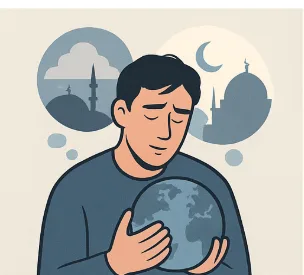
You are sitting in a café in Amsterdam; as you drink coffee with your Dutch colleagues, you feel that you do not belong anywhere. And when you travel to Turkey in the summer, the opposite happens: you notice that you are no longer 'from there' either.
This quiet ache has a name in the psychological literature: acculturation stress. Research shows that this is a measurable, clinical burden, directly linked to depression, lower life satisfaction and anxiety. But it is not a weakness; it is the symptom of a transitional process, and it can be repaired.
What does it mean to be 'caught between two worlds'?
Identity conflict is one of the most fundamental issues in migration psychology. According to the acculturation model of the Canadian psychologist John Berry, an individual living abroad can develop four different adaptation strategies. The first path, which we call integration, is embracing both your own culture and the new culture in a balanced way. The second path is assimilation: setting aside your own culture and moving entirely into the new one. The third is separation: rejecting the new culture and staying only within your own shell. The fourth is the most risky: marginalization, that is, being unable to form a bond with either culture.
Research shows that marginalization in particular leads to serious psychological consequences. An international meta-analysis published in 2024 (Frontiers in Psychology) demonstrated that acculturation stress is directly associated with depression, lower life satisfaction and anxiety. Another 2024 review (Community Mental Health Journal) confirmed that among migrant youth this stress is strongly linked to major depression, anxiety disorders, eating disorders and behavioral problems. So 'being caught in between' is not merely an emotional discomfort, but a measurable, clinical burden.
The current picture in the Netherlands
According to the Dutch mental health monitoring report released at the end of 2025, roughly a quarter of adults in the Netherlands has a psychiatric disorder. Whereas this figure was 17.4 percent in the 2007-2009 period, it rose to 26.1 percent in the 2019-2022 period; women and young people are especially at risk.
The report does not assess Turkish-speaking communities separately. But clinical experience and the international literature show that Turkish-speaking individuals carry a greater stress burden than the general Dutch population: clashing cultural expectations, the difficulty of expressing oneself in two languages, the geographical distance from family ties, occasionally encountered experiences of discrimination, and that well-known feeling of 'not Turkish enough, not Dutch enough'. Research in Germany confirms the same pattern; a study in Berlin and Hamburg (BMC Psychiatry, 2017) showed that depressive disorders among people of Turkish origin are significantly associated with the degree of acculturation.
The silent symptoms of identity conflict
What I most often encounter in clinical practice is this: clients experiencing an identity conflict do not come to the session saying 'I have an identity crisis'. Everything begins with other complaints: chronic fatigue (no one can explain the cause, and it does not lift despite rest), an inability to decide ('which one is my real life?'), relationship problems (especially cultural clashes with a Dutch or German partner, or conversely the feeling with a Turkish partner that 'we no longer understand each other'), uncertainty in raising children ('should my children grow up Turkish, or as locals?'), feelings of panic that arise without any concrete threat, anxiety attacks with no apparent cause, and sometimes the whole burden is reflected in the body: stomach problems, headaches, a tightness in the chest. And in the end, the underlying sentence is always the same: 'I don't know who I am'. Many of these symptoms may meet the diagnostic criteria for depression or anxiety, but the real issue is often overlooked: an underlying problem of identity integrity.
Why is this burden so heavy?
Neuroscience research shows that the brains of bilingual people form different 'emotional maps'. The emotional concepts we learned in our mother tongue, Turkish, words such as gurbet, hasret, kader, ayıp, mahcubiyet, have no exact equivalent in Dutch or German. When a client says 'ik mis je' (I miss you) in Dutch, that sentence does not carry the intensity of the Turkish 'sensiz yapamıyorum' (I can't manage without you).
In therapy, this difference is crucial. Because therapy in a foreign language risks remaining an intellectual exercise; genuine healing, however, is only possible by reaching the deep tissue of the emotions. According to Pavlenko's 2012 Cambridge research, traumatic or emotionally charged memories are mostly stored in the mother tongue and processed in the mother tongue. This is precisely why therapy in the mother tongue makes a real difference, especially when it comes to cultural identity, early trauma or family dynamics.
The particular burden of the second generation: 'those born between two worlds'
The first generation of migrant families came to Europe to 'offer their children a good future'. But the second and third generations, that is, the Turks born and raised in the Netherlands, Germany or Belgium, grew up with an entirely different burden: the burden of being a bridge between two worlds.
A 2021 study of Turkish adolescents in the United Kingdom (Celenk and Van de Vijver) examined how ethnic identity relates to mental health. The result was striking: young people who had actively explored their identity and found clear answers about themselves had markedly higher life satisfaction and stronger self-confidence. Identity conflict is therefore not really a 'problem', but a developmental task; it is just very hard to shoulder that task on your own.
5 practical steps to repair your identity abroad
1. Try to think in 'both-and', not 'either-or'. If your brain presents you with the dilemma 'you are either Turkish or Dutch', that is a cognitive distortion; in reality, many people live by integrating both identities. Being Dutch-Turkish or European-Turkish is possible; these two identities do not have to exclude each other.
2. Maintain your active bond with your mother tongue. Read Turkish books, listen to Turkish podcasts, speak Turkish with your children. As you lose your mother tongue, your bond with your emotional world also weakens; this is not a social luxury, but a psychological need.
3. Create a 'third space' for yourself. Between your circle of Turkish friends and your Dutch work environment, a third space that carries both cultures: second-generation Turks, Turkish-speaking professional groups and intercultural associations can be good starting points.
4. Do not treat experiences of discrimination as 'normal' and pass over them. Micro-aggressions ('what beautiful Turkish you speak', 'I can't understand you at all') accumulate over time; this burden should not be ignored, but recognized and processed. It is one of the areas that brings the most relief in therapy.
5. Draw clear boundaries between your family's expectations and your own life choices. The Turkish family system generally operates on a collectivist dynamic: your happiness is tied to the family's happiness. But you live in Europe, in an individualist society. This tension is not something you can resolve on your own, but awareness is the first and most important step.
When should you seek professional support?
If at least two of the following symptoms have persisted for more than two weeks, you are not too late to consult a specialist: not finding the motivation to get out of bed in the morning, chronic indecision about whether or not to return to Turkey, sleep problems, a marked decline in performance at work or school, ongoing tension in family relationships, no longer taking pleasure in things you used to enjoy, the question 'who am I?' circling endlessly within you, unexplained bodily pains or gastrointestinal complaints. If you recognize several of these in yourself, it is not a 'weakness', but your body trying to tell you something.
Why does Turkish-language online therapy make a difference?
In this period, when waiting times in the GGZ (Dutch mental health care) have risen to 6-12 months, online access to a Turkish-speaking specialist psychologist is a real opportunity for many clients. Sessions are conducted in your mother tongue; you express your emotions without needing translation; you work with a specialist who already knows the cultural context. There is no waiting time, and you can usually begin within 1-2 weeks. Evidence-based approaches such as cognitive behavioral therapy (CBT), Acceptance and Commitment Therapy (ACT), EMDR and emotionally focused therapy (EFT) are methods whose effectiveness for identity conflict and migration-related stress has been scientifically demonstrated.
A final word: being caught in between is not the last stop
The identity conflict you experience abroad is not a weakness, but the symptom of a transitional process. Many people go through this process alone because they cannot find anyone to talk to, whether due to the language barrier or a lack of cultural understanding. But it is possible for this loneliness to come to an end.
Sources: Dutch mental health monitoring report (2025), Trimbos Institute; Horne, C.V. (2024) Journal of Transcultural Nursing; Della Rocca et al. (2025) International Journal of Social Psychiatry 71(2); Berry, J.W. (2005) International Journal of Intercultural Relations 29(6); Celenk & Van de Vijver (2021). This article is for information and does not replace a personal clinical assessment.
Clinical and emergency boundaries
This article is intended solely for general psycho-education and does not replace a diagnosis or personal treatment advice. In the event of an acute crisis, a risk of self-harm or a threat to safety, in the Netherlands contact 112, your huisarts (general practitioner) or the huisartsenpost (after-hours GP service). To talk, the 113 Zelfmoordpreventie helpline (0800-0113) is available day and night.
If you would like support
If the themes in this article noticeably affect your life, you can request an appointment for online Turkish-language therapy or review the frequently asked questions.